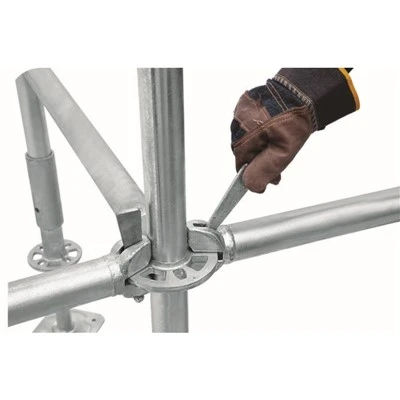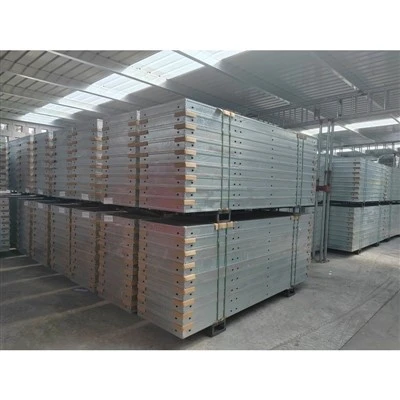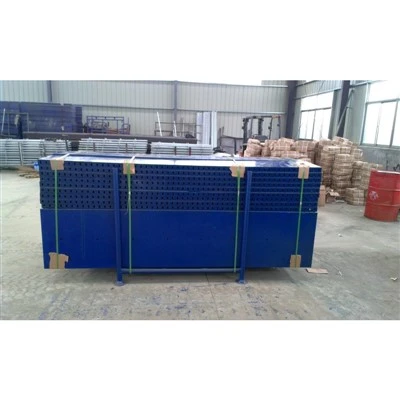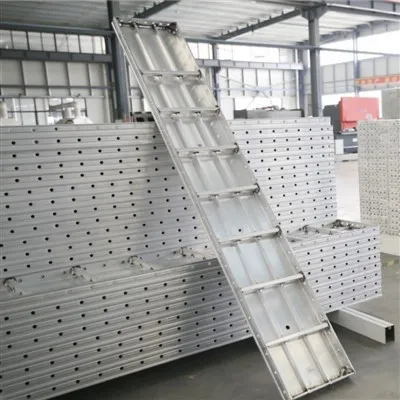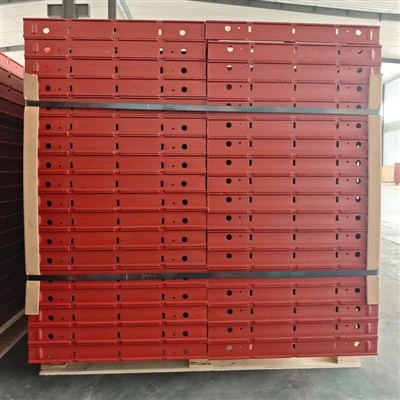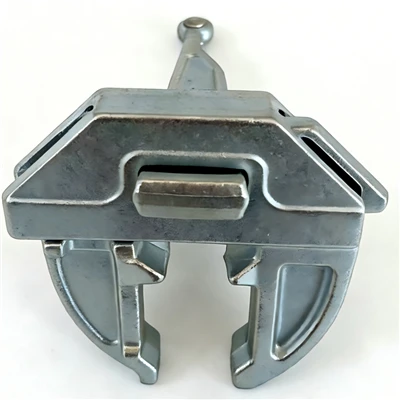
The forming process of aluminum alloy formwork involves processing aluminum alloy sheets or profiles into reusable concrete forming molds. Its core lies in utilizing the advantages of aluminum-lightweight, high-strength, easy to process, and recyclable-through a series of precision processes to achieve accurate dimensions, a smooth surface, and structural stability. This process directly affects the installation efficiency of the formwork, the quality of the concrete forming, and its durability for repeated use.
The process begins with material selection and pretreatment. 6-series aluminum alloys are commonly used in construction due to their good plasticity and corrosion resistance. Upon arrival at the factory, materials must be verified for grade, wall thickness, and mechanical properties, and surface quality must be inspected to remove obvious scratches and oxide layers. To improve forming performance, some sheets undergo annealing before processing to reduce hardness and facilitate subsequent bending and stretching.
The forming stage primarily involves CNC cutting and cold forming. CNC laser or plasma cutting machines are used to cut the sheets to the designed dimensions. The cuts must be smooth and free from thermal deformation to ensure splicing accuracy. For flat panels, shearing machines can be used for direct cutting; for curved or irregularly shaped components, CNC bending machines or roll forming equipment are used for gradual cold bending. Cold forming maintains the original strength and corrosion resistance of the aluminum material while avoiding grain coarsening and performance degradation that may occur with hot working. Complex three-dimensional components can be formed in one step using die stamping, improving efficiency and ensuring shape consistency.
Ribs that enhance rigidity are fixed to the frame via mechanical connections or welding. Aluminum alloys have high thermal conductivity and a large coefficient of linear expansion; therefore, matching aluminum welding wire must be selected and heat input controlled during welding to prevent deformation and cracking. In actual production, riveting, bolting, or special locking methods are commonly used to ensure assembly accuracy and facilitate later disassembly and maintenance. During the trial assembly stage, the flatness of the panel surface and the gaps between joints need to be corrected on a standard platform to ensure smooth on-site installation.
Surface treatment is a crucial step in improving durability and demolding performance. Degreasing and pickling or sandblasting to remove the oxide film, followed by anodizing to form a dense oxide layer, can significantly improve corrosion resistance. Some projects will have an electrophoretic or spray-painted protective coating applied over the oxide layer to adapt to coastal or chemical environments. To facilitate demolding, a specialized release agent will be evenly applied to the panels, forming a release film to reduce concrete adhesion and surface defects.
The entire forming process for pipes and plates emphasizes precision machining and strict quality control, giving the aluminum alloy formwork lightweight portability, dimensional stability, and long-term durability. This enables efficient turnover and high-quality forming in high-rise residential buildings and standardized construction projects.