The crucial role of scaffolding in building construction and maintenance stems from its solid functional foundation-a support system comprised of structural mechanics principles, material performance matching, modular assembly, and safety design. Understanding these foundations helps in grasping why scaffolding can stably bear loads, flexibly adapt, and ensure safe operation.
I. Stable Transfer of Structural Mechanics
The core function of scaffolding is to safely transfer the loads of workers, materials, and equipment to reliable support points. Its members are arranged in a triangular or rectangular grid, utilizing the geometric invariance of triangles to enhance overall rigidity, and forming a stable spatial frame through axial compression of uprights and horizontal constraints of horizontal members. The load is transferred step by step along the scaffold boards → horizontal members → uprights, ultimately reaching the ground or building structure (Example data: Common coupler-type upright spacing is approximately 1.2m, ensuring uniform load distribution and avoiding local buckling). This clear force transmission path and balanced force distribution are the fundamental guarantee of its load-bearing capacity.
II. Matching and Application of Material Properties
The mechanical properties of different materials directly determine the applicable scope of scaffolding. Steel pipes offer high strength and toughness, making them suitable for heavy-duty and high-rise construction; aluminum alloys are lightweight and corrosion-resistant, facilitating flexible handling indoors or in small spaces; while wood is readily available, its strength and durability are insufficient, leading to its reduced use. Matching material selection with factors such as project load and environmental corrosion is crucial to ensuring scaffolding maintains strength while achieving both economy and durability-this is the material foundation for functional implementation.
III. Flexible Construction Through Modular Assembly
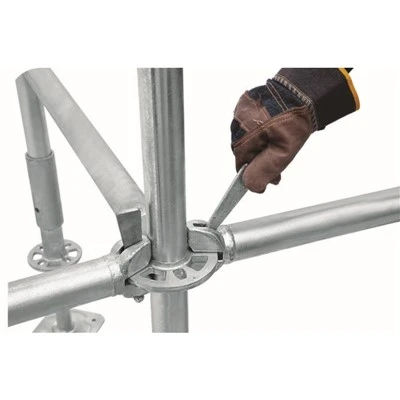
Scaffolding is composed of standardized poles and connectors, which can be assembled into different heights, spans, and shapes as needed. Coupler-type scaffolding relies on bolts for connection at any angle, adapting to complex structures; cup-lock scaffolding uses pins and cup-shaped nodes for quick locking, improving erection efficiency; portal frame scaffolding uses prefabricated frame units, suitable for large-area flat work. Modular design allows scaffolding to quickly respond to various construction needs, forming corresponding platforms from main structure pouring to exterior wall decoration, demonstrating functional scalability.
IV. Comprehensive Protection Through Safety Design
The functional foundation includes not only load-bearing and erection but also the prevention and control of operational risks. The scaffolding is equipped with guardrails and toe boards, along with safety nets, to prevent personnel and materials from falling. Strength calculations for joint connections and wind load considerations ensure stability even in adverse environments. Standardized erection, inspection, and maintenance maintain the reliability of the functional foundation, ensuring both load-bearing capacity and safety.
Overall, the functional foundation of scaffolding is an organic integration of structural mechanics, material properties, modular assembly, and safety design. These four elements complement each other, enabling it to provide stable load-bearing capacity, flexible adaptability, and, most importantly, safeguard construction safety, becoming an indispensable technical support for high-altitude operations.