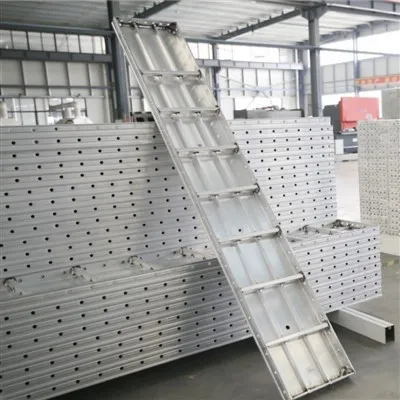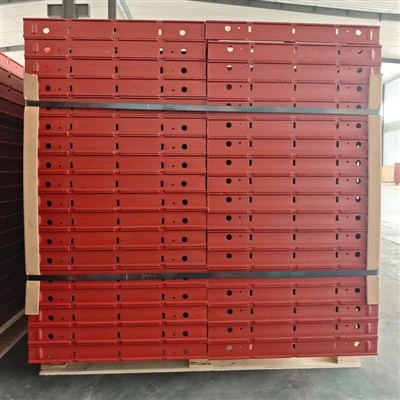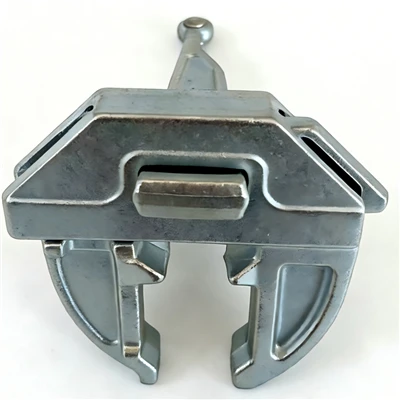
Steel formwork is a type of standardized formwork made primarily of steel. It is widely used in concrete structure construction to form the surfaces of beams, columns, wall panels, floor slabs, and other components. Compared to traditional formwork such as wooden formwork and bamboo plywood, it offers significant advantages in strength, durability, and reusability, thus playing a crucial role in modern building engineering, bridge engineering, and precast component production.
The core characteristics of steel formwork lie in its high rigidity and dimensional stability. Formed from pressed steel plates, and equipped with steel frames and stiffening ribs, it can withstand the significant lateral pressure of concrete pouring without easily deforming, ensuring the flatness of the formed surface and the accuracy of its geometric dimensions. This stability results in a clear structural outline after pouring, reducing the need for repairs and grinding, and also lowering the risk of thickness deviations caused by formwork deformation. Furthermore, steel has good water and corrosion resistance, maintaining its shape and strength even under repeated use in humid environments or different climatic conditions, resulting in a service life far exceeding that of most non-metallic formwork.
In terms of construction efficiency, steel formwork primarily employs standardized design and modular assembly, allowing for rapid assembly into integral or segmented systems based on structural shapes. Once workers are familiar with the connection methods, hoisting and fixing can be completed in a short time, shortening the formwork support cycle. Due to its reusability, a single set of steel formwork can be reused across multiple projects, reducing timber consumption and waste generation, aligning with the conservation principles of green construction. For continuous pouring of large-volume concrete or tall structures, the stability and airtightness of steel formwork can reduce grout leakage and improve appearance quality.
The adaptability of steel formwork is reflected in its customizability and scalability. For beams and columns with different cross-sectional shapes, curved walls, or irregularly shaped components, panels with corresponding curvatures or angles can be specially processed. In bridge engineering, it can be used in conjunction with hanging baskets or mobile formwork to form enclosed enclosures for segmental construction. In prefabrication plants, it can be combined with facilities such as vibrating tables and curing kilns to achieve high precision and efficiency in mass production. Material selection also allows for the use of ordinary carbon steel, alloy steel, or stainless steel based on corrosion resistance, fire resistance, or lightweight requirements, meeting the special requirements of marine, chemical, or high-temperature environments.
Although the initial investment in steel formwork is higher than that of ordinary formwork, its overall cost is more advantageous when amortized through multiple uses. Its standardization, high precision, and durability not only improve the quality of concrete forming but also make construction organization more controllable and the pace more stable.
Overall, steel formwork is a type of construction equipment whose core values are robustness, durability, dimensional accuracy, and efficient repeatability. It provides reliable forming assurance for modern concrete structure engineering and plays a vital role in promoting the industrialization and refinement of construction.